Not surprisingly, I've been felled by a sinus infection. Seems that burnout compromises our immune system. Go figure.
I've been trying to catch up on some great posts by fellow bloggers. Check these out if you can: On gothic literature, BikeProf and Kate weigh in. Danielle provides her insights on Turn of the Screw. Dorothy W. waxes poetic on Proust and Joyce. And Litlove cannily discusses the uncanny.
I've been experiencing some uncanny-ness myself as of late. I've been getting what I call "signs from the universe." These are the little taps on the shoulder from god or a Higher Power or what-have-you that ask if you are paying attention to your life. It has been my experience that when you ignore the shoulder-taps, they turn into shoves.
The taps have to do with writing and my building my life around this vocation, versus having to build my writing around my life (a perennial concern of mine, which I know other writers share). One big honking tap: A great idea emerged on how to begin my novel, a situation that had been perplexing me for many a moon. Two more taps: Two of my writer friends are taking great strides in their writing lives. And a few more taps: Various and sundry people have been asking me about or reminding me to dust off The Novel.
So, looks like I'll soon, once again, be reinventing my life.
In other literary stewpot news, I'm still in Lite Mode. (Witness my blog entries.) Can't focus on deep reading (another tap--more like an anti-tap, if there is such a thing. A thwack on the forehead from an angel's thumb and forefinger). So, I've been culling my shelves for light mysteries. Thanks to my RIP Challenge reading, I've de-snobbed my literary habits and let some genre reading shine in. Finished Dianne Day's Fire and Fog, an enjoyable mystery about the Great San Francisco earthquake (plus: a strong heroine, minus: a little weak on historical ambience. And she used "myriad of," a pet grammar peeve of mine), and am currently reading Jane Langton's Emily Dickinson is Dead (plus: quotes from the poetess and lots of Amherst references, minus: rife with stereotypes). In between, I wove in Poker Face, an interesting little memoir by Kate Lederer, sister of poker professionals Howard Lederer and Annie Duke. Frustrating as it is to put off Deep Thoughts and Serious Reading, I am learning many literary lessons: Tolerance for the Light Read 101, Fun with Plot, What NOT to do when Writing your own Novel Workshop, and Reading with Burnout for Dummies.
Y'all have a great weekend and, if you haven't Hallween memed yet (see my previous entry), then get to it! I need to add some TBR horror lit and sci-fi/fantasy books to my list!
10.06.2006


10.02.2006
A Halloween meme
The trees grow bare, the air turns chill. Now is the time to treat yourself to your favorite wool sweater, a cup of hot cider and a Halloween meme. In honor of Carl V., for his wonderful RIP Challenge. Tag, Carl, and other RIP participants!
1. What is your favorite work of horror fiction? Of all the chillers and thrillers, I still return to Irving Washington’s The Legend of Sleepy Hollow. It’s just a darn good story.
2. What is your favorite work of science fiction/fantasy? I’m not a big sci-fi fan, but I have to say, The Selected Stories of Philip K. Dick’s are amazingly imaginative (if not the best written). Includes The Minority Report and We Can Remember It for You Wholesale (the movie Total Recall is based on this story).
3. Who is your favorite monster? Frankenstein. Sure, he’s a fiend, but he’s got heart.
4. What horror movie gives you the most chills? Tough call. The Exorcist is spooky even on repeated viewings, but for sheer creepy atmosphere, I’m going with Tod Browning’s Freaks.
5. Freddy versus Jason? The silent treatment is always the worst. And a hockey mask is very scary.
6. What is your favorite Halloween treat? Miniature Snickers.
7. Ghosts or goblins? Ghosts. (What is a goblin anyway?)
8. What is your scariest encounter with the paranormal? The closest I’ve come was at Pere Lachaise Cemetery in Paris. I had the feeling that there was something – spirits? – watching me from the trees. I didn’t feel scared, but I did feel strange because I didn’t understand what the “something” was.
9. Do you believe in ghosts? Not really. I’m sure there is a scientific explanation (properties of physics and such) to so-called paranormal activity. That doesn't keep me from watching the Travel Channel's Most Haunted or Sci-Fi Channel's Ghost Hunters! (Aren't Jason and Grant cute?)
10. Favorite Halloween costume? I have an idea to go as a Rorschach ink blot. I want to get a black T-shirt and fingerpaint a white abstract image on it. Then, when people ask “What are you?”, I can reply, “What do you think I am?”
1. What is your favorite work of horror fiction? Of all the chillers and thrillers, I still return to Irving Washington’s The Legend of Sleepy Hollow. It’s just a darn good story.
2. What is your favorite work of science fiction/fantasy? I’m not a big sci-fi fan, but I have to say, The Selected Stories of Philip K. Dick’s are amazingly imaginative (if not the best written). Includes The Minority Report and We Can Remember It for You Wholesale (the movie Total Recall is based on this story).
3. Who is your favorite monster? Frankenstein. Sure, he’s a fiend, but he’s got heart.
4. What horror movie gives you the most chills? Tough call. The Exorcist is spooky even on repeated viewings, but for sheer creepy atmosphere, I’m going with Tod Browning’s Freaks.
5. Freddy versus Jason? The silent treatment is always the worst. And a hockey mask is very scary.
6. What is your favorite Halloween treat? Miniature Snickers.
7. Ghosts or goblins? Ghosts. (What is a goblin anyway?)
8. What is your scariest encounter with the paranormal? The closest I’ve come was at Pere Lachaise Cemetery in Paris. I had the feeling that there was something – spirits? – watching me from the trees. I didn’t feel scared, but I did feel strange because I didn’t understand what the “something” was.
9. Do you believe in ghosts? Not really. I’m sure there is a scientific explanation (properties of physics and such) to so-called paranormal activity. That doesn't keep me from watching the Travel Channel's Most Haunted or Sci-Fi Channel's Ghost Hunters! (Aren't Jason and Grant cute?)
10. Favorite Halloween costume? I have an idea to go as a Rorschach ink blot. I want to get a black T-shirt and fingerpaint a white abstract image on it. Then, when people ask “What are you?”, I can reply, “What do you think I am?”
9.28.2006
Gothic: The original chick-lit? - RIP Challenge #4 - Dragonwyck, Anya Seton
Atmosphere: Romantic
Chill factor: Definitely pelerine weather
Is gothic the original chick-lit?
This speculation occurred to me after finishing Anya Seton’s Dragonwyck. The whole RIP Challenge has awakened an interest in gothic literature: how the genre started, what constitutes gothic, the genre’s history. I feel as if I’ve stumbled upon a whole new area of literary study (for me).
I’ve learned, for example, that Horace Walpole’s The Castle of Otranto, published in 1764, is considered the first gothic story, and that Ann Radcliffe’s The Mysteries of Udolpho, from 1794, first combined gothic and romance. Apparently, from these books spawned gothics of various stripes, from Jane Austen’s spoof in Northanger Abbey to the Bronte sisters’ psychological gothics, straight on through to Anne Rice’s vampire stories, which (I presume) combine horror and gothic elements.
In between all of that came Dragonwyck. First published in 1944, Dragonwyck is considered a classic gothic romance. While I admittedly am not quite sure what that means, I would guess that, once Ann Radcliffe, in the throes of the Romantic period, merged gothic and romance, the genre pretty much belonged to female authors and readers. And maybe gothic-for-men became crime/detective/horror fiction. Certainly a gross generalization, and I’d really be interested in other views on this.
For some reason, the whole question of what constitutes genre is piquing my interest as of late. (Perhaps it was BikeProf’s discussions of pulp over at The Hobgoblin of Little Minds. ) Why do literary genres form? For reader convenience? From social trends? Both? Do genres hurt or help fiction in the long-run (i.e. do they inhibit creativity or do they in fact inspire new developments)? Wish I could speculate further (and with much more pep)…well, when I’m not as harried, I will do more research and further posts.
As for my enjoyment of Dragonwyck—ultimately, I did enjoy the book. I found it difficult to accept the book within its conventions (I’m not a fan of romance or historical fiction), especially the overt descriptions of character motivations and emotions. As a reader, I’d prefer to discover these things through action and dialogue. And despite my pronouncements on the ambiguity of Henry James, I don’t enjoy the neatly wrapped-up ending, as Seton employs here. But, around about the 160-page mark, the story hauled me in, and as the novel neared its end, I found myself unable to put the book down. Seton certainly captured the essence of the period (1840s) and place (Hudson River environs), and she did evoke the whole something’s-not-quite-right-here atmosphere requisite for a gothic novel.
Now, ever the fussy kitty, I have to say that I can’t understand why on earth the heroine Miranda fell for Nicholas. So he was rich and handsome. Big deal. He was a jerk. I was immediately rooting for Dr. Jeff Turner, the doctor-cum-humanitarian. I realize that’s a convention of a gothic romance (heroine falls for rich unattainable jackass until she comes to her senses and runs off with the nice Everyman, conveniently with the jackass’s money), but if I could have slapped Miranda through the pages, I would have.
Update on yesterday’s freak-out: Last night I read one of Edith Wharton’s ghost stories. Yes, I had to reread several pages a few times, but I did it. The whole episode really pissed me off. Because I feel myself slipping away. I want my zippy, smart voice to come back. I want to have lunch. I want to be able to appreciate a cultural event higher than who wins Project Runway. Something will change soon, by gum, or my name isn’t The Literate Kitten. Gerrrowwwwlllll.
Chill factor: Definitely pelerine weather
Is gothic the original chick-lit?
This speculation occurred to me after finishing Anya Seton’s Dragonwyck. The whole RIP Challenge has awakened an interest in gothic literature: how the genre started, what constitutes gothic, the genre’s history. I feel as if I’ve stumbled upon a whole new area of literary study (for me).
I’ve learned, for example, that Horace Walpole’s The Castle of Otranto, published in 1764, is considered the first gothic story, and that Ann Radcliffe’s The Mysteries of Udolpho, from 1794, first combined gothic and romance. Apparently, from these books spawned gothics of various stripes, from Jane Austen’s spoof in Northanger Abbey to the Bronte sisters’ psychological gothics, straight on through to Anne Rice’s vampire stories, which (I presume) combine horror and gothic elements.
In between all of that came Dragonwyck. First published in 1944, Dragonwyck is considered a classic gothic romance. While I admittedly am not quite sure what that means, I would guess that, once Ann Radcliffe, in the throes of the Romantic period, merged gothic and romance, the genre pretty much belonged to female authors and readers. And maybe gothic-for-men became crime/detective/horror fiction. Certainly a gross generalization, and I’d really be interested in other views on this.
For some reason, the whole question of what constitutes genre is piquing my interest as of late. (Perhaps it was BikeProf’s discussions of pulp over at The Hobgoblin of Little Minds. ) Why do literary genres form? For reader convenience? From social trends? Both? Do genres hurt or help fiction in the long-run (i.e. do they inhibit creativity or do they in fact inspire new developments)? Wish I could speculate further (and with much more pep)…well, when I’m not as harried, I will do more research and further posts.
As for my enjoyment of Dragonwyck—ultimately, I did enjoy the book. I found it difficult to accept the book within its conventions (I’m not a fan of romance or historical fiction), especially the overt descriptions of character motivations and emotions. As a reader, I’d prefer to discover these things through action and dialogue. And despite my pronouncements on the ambiguity of Henry James, I don’t enjoy the neatly wrapped-up ending, as Seton employs here. But, around about the 160-page mark, the story hauled me in, and as the novel neared its end, I found myself unable to put the book down. Seton certainly captured the essence of the period (1840s) and place (Hudson River environs), and she did evoke the whole something’s-not-quite-right-here atmosphere requisite for a gothic novel.
Now, ever the fussy kitty, I have to say that I can’t understand why on earth the heroine Miranda fell for Nicholas. So he was rich and handsome. Big deal. He was a jerk. I was immediately rooting for Dr. Jeff Turner, the doctor-cum-humanitarian. I realize that’s a convention of a gothic romance (heroine falls for rich unattainable jackass until she comes to her senses and runs off with the nice Everyman, conveniently with the jackass’s money), but if I could have slapped Miranda through the pages, I would have.
Update on yesterday’s freak-out: Last night I read one of Edith Wharton’s ghost stories. Yes, I had to reread several pages a few times, but I did it. The whole episode really pissed me off. Because I feel myself slipping away. I want my zippy, smart voice to come back. I want to have lunch. I want to be able to appreciate a cultural event higher than who wins Project Runway. Something will change soon, by gum, or my name isn’t The Literate Kitten. Gerrrowwwwlllll.
9.27.2006
It happened
Last night. The most awful thing. Well, not most awful. But pretty darn awful.
I could not read.
I got into bed, snuggled in for my usual read, opened a book and--gibberish. Couldn't focus on one sentence. Put that down and picked up another. Same thing. Another. Ditto. On and on it went through seven books of various weights, topics, genres.
Just too exhausted.
Horrible.
Let's see what happens tonight.
I could not read.
I got into bed, snuggled in for my usual read, opened a book and--gibberish. Couldn't focus on one sentence. Put that down and picked up another. Same thing. Another. Ditto. On and on it went through seven books of various weights, topics, genres.
Just too exhausted.
Horrible.
Let's see what happens tonight.
9.26.2006
Who are The Dead?
Cross-posted at A Curious Singularity
I've been enjoying everyone's comments on this story, and plink-plink, here are my two cents:
The Dead is simply a superb short story, one of the best in the English language. Joyce realizes near perfection (though never strained) in integrating character, imagery, plot and theme. When the ending comes, so eloquently, these elements fuse together with the language for one of the most satisfying and poignant epiphanies ever written. This is what all short stories aim (or should aim) to achieve. I thought I would share insights from a critical text I have on Joyce’s The Dubliners, A Reader’s Guide to James Joyce, William York Tindall. This passage also addresses, I think, Kate’s question: Who are the dead of the story?:
…The theme involves the sins of pride, envy, lust, wrath, and the virtue of charity. From conflicts of death and life, lust and love, taking and giving, past and present, self and selflessness knowledge emerges at last and with it the triumph of love. The dead and the living dead lie uncovered for our inspection, but promises renewal. (Gabriel's) New Year may be new indeed. Fixing this moral theme and its implications is important since character, structure, image, and the other elements work together in its service, and to know the many we must know the one. All the parts (even pictures on the wall or Mr. d’Arcy’s cold in the head) seem as functional as the parts of something by Mozart. Wholeness, harmony, and radiance, Stephen’s requirements for any work of art (from Portrait of an Artist as a Young Man), were never more evident. Like music, but not music, this radiant harmony is both absolute and referential. The Dead is a structure of references or meanings, which, like those of all great literature, are human—not all superhuman like those of Mozart.
He goes on to describe Gabriel's situation at the end of the story:
...His self destroyed, his identity gone, he becomes one with all the living and the dead. This dramatic extinction of personality could be another hopeful sign (of Gabriel's ability to change). No longer Gabriel alone but one with everyone, he may be redy to accept, give, and participate.
The essay goes on in length, and is quite illuminating. I recommend the book for James Joyce readers.
I've been enjoying everyone's comments on this story, and plink-plink, here are my two cents:
The Dead is simply a superb short story, one of the best in the English language. Joyce realizes near perfection (though never strained) in integrating character, imagery, plot and theme. When the ending comes, so eloquently, these elements fuse together with the language for one of the most satisfying and poignant epiphanies ever written. This is what all short stories aim (or should aim) to achieve. I thought I would share insights from a critical text I have on Joyce’s The Dubliners, A Reader’s Guide to James Joyce, William York Tindall. This passage also addresses, I think, Kate’s question: Who are the dead of the story?:
…The theme involves the sins of pride, envy, lust, wrath, and the virtue of charity. From conflicts of death and life, lust and love, taking and giving, past and present, self and selflessness knowledge emerges at last and with it the triumph of love. The dead and the living dead lie uncovered for our inspection, but promises renewal. (Gabriel's) New Year may be new indeed. Fixing this moral theme and its implications is important since character, structure, image, and the other elements work together in its service, and to know the many we must know the one. All the parts (even pictures on the wall or Mr. d’Arcy’s cold in the head) seem as functional as the parts of something by Mozart. Wholeness, harmony, and radiance, Stephen’s requirements for any work of art (from Portrait of an Artist as a Young Man), were never more evident. Like music, but not music, this radiant harmony is both absolute and referential. The Dead is a structure of references or meanings, which, like those of all great literature, are human—not all superhuman like those of Mozart.
He goes on to describe Gabriel's situation at the end of the story:
...His self destroyed, his identity gone, he becomes one with all the living and the dead. This dramatic extinction of personality could be another hopeful sign (of Gabriel's ability to change). No longer Gabriel alone but one with everyone, he may be redy to accept, give, and participate.
The essay goes on in length, and is quite illuminating. I recommend the book for James Joyce readers.
9.25.2006
Final Turn of the Screw
In my last (thankfully) look at The Turn of the Screw, I wanted to review James’s device of word repetition. He repeats a number of words or phrases, and I wonder if the repetition adds layers to the meaning.
One example I tracked was the word “innocent,” (or a variation thereof) which appears at least 13 times in the novella, referring to children other than Miles and Flora, individually and together to Miles and Flora and even to the governess herself. Here are just a few of the uses:
The first reference appears during a conversation between the governess and Mrs. Grose concerning Miles’s expulsion from school and refers to other children:
I found myself, to meet my friend the better, offering it, on the spot, sarcastically. “To his poor little innocent mates!”
One, at the beginning of section IX, refers to both Miles and Flora:
Putting things at the worst, at all events, as in meditation I so often did, any clouding of their innocence could only be—blameless and foredoomed as they were—a reason the more for taking risks.
This refers to the governess herself, after seeing Quint peering into the house:
I could meet on this, without scruple, any innocence.
And, the last reference is to Miles:
I seemed to float not into clearness, but into a darker obscure, and within a minute there had come to me out of my very pity the appalling alarm of his being perhaps innocent. It was for the instant confounding and bottomless, for if he were innocent, what then on earth was I?
Frankly, I am not sure what to make of all this, except that if James used a word 13 times in one novella, he must have had a good reason. Anyone else care to speculate on how James is using word repetition here?
One example I tracked was the word “innocent,” (or a variation thereof) which appears at least 13 times in the novella, referring to children other than Miles and Flora, individually and together to Miles and Flora and even to the governess herself. Here are just a few of the uses:
The first reference appears during a conversation between the governess and Mrs. Grose concerning Miles’s expulsion from school and refers to other children:
I found myself, to meet my friend the better, offering it, on the spot, sarcastically. “To his poor little innocent mates!”
One, at the beginning of section IX, refers to both Miles and Flora:
Putting things at the worst, at all events, as in meditation I so often did, any clouding of their innocence could only be—blameless and foredoomed as they were—a reason the more for taking risks.
This refers to the governess herself, after seeing Quint peering into the house:
I could meet on this, without scruple, any innocence.
And, the last reference is to Miles:
I seemed to float not into clearness, but into a darker obscure, and within a minute there had come to me out of my very pity the appalling alarm of his being perhaps innocent. It was for the instant confounding and bottomless, for if he were innocent, what then on earth was I?
Frankly, I am not sure what to make of all this, except that if James used a word 13 times in one novella, he must have had a good reason. Anyone else care to speculate on how James is using word repetition here?
9.22.2006
Oldies but goodies

It's Friday. The end of a truly noxious week here in an anonymous cubicle somewhere in the heart of San Francisco. I'm ready for a bit of nonsense...
Don't know why, except the synapses are starting to fray at the edges, but I started to reminisce about books I was quite fond of as a pre-teen. It took a bit to recall the titles, but I did. Here's the list, and what I can recall about each book. Does anybody else remember these? Please, add more to the list!
Maureen Daly, Seventeenth Summer. Man, I read this one many times over, when I was 10, 11...? I swooned over the part where Jack kisses Angie for the first time: End of summer, autumn chill in the air, they went to pick tomatoes or something, and then Jack took Angie's face in his chilled, muddy hands, and...
It was a great scene; the whole book built up to it. I'm glad I was young when I was young. I'm sure that a little old kiss at the end of the summer wouldn't be half so thrilling to 10-year-olds these days.
I also remember something about the older sister Lorraine washing her slips out every night in the sink, the hot mugginess of the summer nights, and a sense of ineffable longing.
Paul Zindel, My Darling, My Hamburger. I remember it was funny. I remember someone named Liz and I think her boyfriend was Sean. I don't recall a hamburger. I think kids still read this book, don't they?
Patricia Dizenzo, Phoebe. I was in the sixth grade (Catholic school, Sister Mary Ann and her cat's-eye glasses) when I checked this book out of the local library. It was about a girl getting pregnant. Very racy for my milieu. Naturally, all the other girls in the sixth grade wanted to borrow it. Naturally, I was eager to loan it out. Well, my best friend Cheryl was reading it during a study period and got caught and snitched on me. Sister Mary Ann, who I suspect was actually Andy Dick in a nun's habit, was shocked and called my mother to let her know I was reading a book that -- here her voice lowered to a whisper -- included the words "missed period" on the book cover flap. When I got home my mom asked to look at the book, read the inside flap and then handed the book back to me, saying in her best semi-bored tone, "Just don't take those kinds of books to school anymore."
The Partridge Family #2: The Haunted Hall. Two things I remember about this book: I read this over and over until some of the pages stuck together when I accidentally spilled chocolate pudding on it. It was supposed to be a gothic, as I recall, and I remember that Laurie Partridge (the book's heroine) referred to Heathcliffe in it, which somehow seemed extremely romantic to me (I was 10, okay!). Can you believe someone is auctioning this book on eBay? Very tempting.
Judy Blume, Are you there God, It’s me Margaret? I remember laughing out loud and being somewhat shocked (and delighted, naturally) over Margaret's precocious conversations with God. Talk to God about periods (missed or otherwise)? What a rebel! (I was going to a school where we weren't supposed to wear shorts under our uniforms because it was deemed unladylike. I asked a priest -- Father Deacon -- no lie -- how the teachers could tell if we wore shorts under our uniform or not. I got kicked out of class. Another time he put his hands over his eyes and said "Ladies, cross your legs. I'm seeing things I shouldn't see." And I said, "Why are you looking?" I got kicked out for that, too.)
Still turning the screw
Before I begin, let me say, before I’m accused of crankiness, that I admire James’s prose; let’s face it, the guy knows his way around a sentence. The book I purchased with Turn of the Screw also includes other shorter novellas (Daisy Miller and The Aspern Papers, among others), which I plan to read. I also intend to keep my promise of a Thanksgiving Readers’ Choice (if you want to weigh in, click here.)
There are so many ways to read this story, one can get lost. I choose to focus on two aspects that struck me as I read: the male/female dynamic and the recurrence of the word “innocent.”
To me, the ghosts represent corruption – the corrupt aspect of a male/female union, if you will. In James’s time, the corruption lay (by implication of the governess and Mrs. Grose) in the fact that the unmarried Miss Jessel had carnal relations with Quint—the twin sin being fornication with a man of a lower class. The children, of course, represent the uncorrupt aspect of male and female, not only by virtue of their youth but also by the fact that they are brother and sister (and therefore, a nonsexual relationship). The tension set up by this dynamic is strengthened by the representation of another type of male/female relationship, that of the governess and her employer. This relationship does not enjoy a clear role assignment, nor absolute boundaries. The master is utterly absent and disinterested; yet, he wields quite a bit of authority over the governess. The governess, on the other hand, becomes almost inexplicably devoted and loyal to her employer, even willing to put her charges at risk to please him. The master is of a higher class than his employee, which would preclude his marrying her, yet she seems content to capture his affections in the only way she knows how: by eradicating herself from his life. James further turns the screw on this dynamic by omitting from his story the most socially accepted form of male/female relationships: the married couple. The innocent children are essentially orphans, a plight which the story glosses over. These innocent, charming, beautiful creatures are forced to be parented by an absent patriarch and all-present matriarch.
Ultimately, the imbalance in the relationship between the master and the governess harms the children. The governess takes on all responsibility, and the children are at the mercy of her world-view. In her zeal to protect them, she destroys their innocence—she ruins the very thing she has sought to preserve. (Maybe George Bush could read this after he finishes The Stranger.)
One particular red herring that bothered me was the fact that that neither the governess nor Mrs. Grose queried the schoolmaster about Miles’s dismissal. The governess is spirited enough to take on ghosts; can’t she even buck authority enough to ask a lowly teacher about such an important issue? Within the convention of the story, of course, the governess couldn’t find out, so James just sidestepped the issue.
I’ll end here, and add my bit about the recurrence of the word “innocent” in the next post.
There are so many ways to read this story, one can get lost. I choose to focus on two aspects that struck me as I read: the male/female dynamic and the recurrence of the word “innocent.”
To me, the ghosts represent corruption – the corrupt aspect of a male/female union, if you will. In James’s time, the corruption lay (by implication of the governess and Mrs. Grose) in the fact that the unmarried Miss Jessel had carnal relations with Quint—the twin sin being fornication with a man of a lower class. The children, of course, represent the uncorrupt aspect of male and female, not only by virtue of their youth but also by the fact that they are brother and sister (and therefore, a nonsexual relationship). The tension set up by this dynamic is strengthened by the representation of another type of male/female relationship, that of the governess and her employer. This relationship does not enjoy a clear role assignment, nor absolute boundaries. The master is utterly absent and disinterested; yet, he wields quite a bit of authority over the governess. The governess, on the other hand, becomes almost inexplicably devoted and loyal to her employer, even willing to put her charges at risk to please him. The master is of a higher class than his employee, which would preclude his marrying her, yet she seems content to capture his affections in the only way she knows how: by eradicating herself from his life. James further turns the screw on this dynamic by omitting from his story the most socially accepted form of male/female relationships: the married couple. The innocent children are essentially orphans, a plight which the story glosses over. These innocent, charming, beautiful creatures are forced to be parented by an absent patriarch and all-present matriarch.
Ultimately, the imbalance in the relationship between the master and the governess harms the children. The governess takes on all responsibility, and the children are at the mercy of her world-view. In her zeal to protect them, she destroys their innocence—she ruins the very thing she has sought to preserve. (Maybe George Bush could read this after he finishes The Stranger.)
One particular red herring that bothered me was the fact that that neither the governess nor Mrs. Grose queried the schoolmaster about Miles’s dismissal. The governess is spirited enough to take on ghosts; can’t she even buck authority enough to ask a lowly teacher about such an important issue? Within the convention of the story, of course, the governess couldn’t find out, so James just sidestepped the issue.
I’ll end here, and add my bit about the recurrence of the word “innocent” in the next post.
9.21.2006
RIP Challenge #3 - The Turn of the Screw, Henry James
Atmosphere: Ambiguous
Chill Factor: A sprinkle of hair-raising with intermittent goosebumps
I was hampered in this reading by two things: Henry James’s prose and the fact that I’ve seen the Deborah Kerr movie. Therefore, I read this novella twice.
Reading James is a little like riding a bumper car: You never know when you’ll have to switch directions to avoid getting slammed from behind. Example:
It took of course more than that particular passage to place us together in presence of what we had now to live with as we could—my dreadful liability to impressions of the order so vividly exemplified, and my companion’s knowledge henceforth—a knowledge half consternation and half compassion—of that liability.
Having gotten past those first two obstacles—rereading helped believe it or not, my understanding if not my humor—though I wonder if having said I read it twice, I am not adding the liability henceforth of writing like James himself—the first issue to address, I suppose, is: are the ghosts in this story real?
James leads us to believe they are. How else does the governess describe (down to the red hair) Quint so accurately, so soon after arriving at Bly? But if you believe the ghosts are real, does that lead you to question your own sanity?
Okay, maybe the governess happened to see a daguerreotype (a four-color one, the first of its kind) of the scoundrel that happened to be propped on a fireplace mantel, and she is such a smart governess, she guessed who the man was. Then her whole story makes her the whack job (not you). Which makes her whole account noncredible. So, why read the story?
Hmmm...something’s getting screwed, all right. Thanks, Henry.
I am going to handle the whole ghost question by reading this story as any other ghost story and accepting the literary conventions of the genre. Perhaps James even left a signpost for me, by using the device of a story within a story (the gentleman’s story of the governess’s written account). A similar device is used by Irving in Sleepy Hollow, among many other ghost stories.
Given that the ghost is real within the realm of the story, I turn to other literary devices to guide me as to how to read it: to wit, motif and metaphor. Analyzing just these two devices (forget POV, voice, theme and other literary whatnot), trying to keep track of motifs and metaphors in this story is about as fruitful as trying to figure out whether or not the governess is a reliable narrator. For a novella, James virtually crams motif and metaphor into every nook and cranny. Light/dark, silence/quiet, vision/sight, the turning screw. My God. You can’t turn a page without dusk falling or a candle being snuffed out.
In this way, I think James ultimately deflates his story. It is so loaded as to be ambiguous. And the ambiguity he creates ultimately did not satisfy me as a reader. I enjoyed the idea, I lived with the execution, but I did not give a whit about the resolution--which is to say, no resolution.
There are almost too many puzzle pieces, and once assembled, they don’t ever quite present a whole picture. Or, maybe this is more like it, James creates a veritable maze, where all paths are dead ends. (I should teach James a lesson and add a bunch of other metaphors here, but I am sure you get the idea.)
However, I am going to isolate and analyze a few of the many maze-paths James left in my next blog post, namely, the male/female dynamic and the repetition of the word “innocent.”
Still in work hell. RIP, normalcy. Nice knowing you, sanity. See you later, energy.
Chill Factor: A sprinkle of hair-raising with intermittent goosebumps
I was hampered in this reading by two things: Henry James’s prose and the fact that I’ve seen the Deborah Kerr movie. Therefore, I read this novella twice.
Reading James is a little like riding a bumper car: You never know when you’ll have to switch directions to avoid getting slammed from behind. Example:
It took of course more than that particular passage to place us together in presence of what we had now to live with as we could—my dreadful liability to impressions of the order so vividly exemplified, and my companion’s knowledge henceforth—a knowledge half consternation and half compassion—of that liability.
Having gotten past those first two obstacles—rereading helped believe it or not, my understanding if not my humor—though I wonder if having said I read it twice, I am not adding the liability henceforth of writing like James himself—the first issue to address, I suppose, is: are the ghosts in this story real?
James leads us to believe they are. How else does the governess describe (down to the red hair) Quint so accurately, so soon after arriving at Bly? But if you believe the ghosts are real, does that lead you to question your own sanity?
Okay, maybe the governess happened to see a daguerreotype (a four-color one, the first of its kind) of the scoundrel that happened to be propped on a fireplace mantel, and she is such a smart governess, she guessed who the man was. Then her whole story makes her the whack job (not you). Which makes her whole account noncredible. So, why read the story?
Hmmm...something’s getting screwed, all right. Thanks, Henry.
I am going to handle the whole ghost question by reading this story as any other ghost story and accepting the literary conventions of the genre. Perhaps James even left a signpost for me, by using the device of a story within a story (the gentleman’s story of the governess’s written account). A similar device is used by Irving in Sleepy Hollow, among many other ghost stories.
Given that the ghost is real within the realm of the story, I turn to other literary devices to guide me as to how to read it: to wit, motif and metaphor. Analyzing just these two devices (forget POV, voice, theme and other literary whatnot), trying to keep track of motifs and metaphors in this story is about as fruitful as trying to figure out whether or not the governess is a reliable narrator. For a novella, James virtually crams motif and metaphor into every nook and cranny. Light/dark, silence/quiet, vision/sight, the turning screw. My God. You can’t turn a page without dusk falling or a candle being snuffed out.
In this way, I think James ultimately deflates his story. It is so loaded as to be ambiguous. And the ambiguity he creates ultimately did not satisfy me as a reader. I enjoyed the idea, I lived with the execution, but I did not give a whit about the resolution--which is to say, no resolution.
There are almost too many puzzle pieces, and once assembled, they don’t ever quite present a whole picture. Or, maybe this is more like it, James creates a veritable maze, where all paths are dead ends. (I should teach James a lesson and add a bunch of other metaphors here, but I am sure you get the idea.)
However, I am going to isolate and analyze a few of the many maze-paths James left in my next blog post, namely, the male/female dynamic and the repetition of the word “innocent.”
Still in work hell. RIP, normalcy. Nice knowing you, sanity. See you later, energy.
9.18.2006
Ichabod Crane Pumpkin Cream Cheese Muffins
Just when I thought I was busy, things amped up about 100%. I intend to catch up on my blog reading and posting soon. (I finished "The Turn of the Screw," "The Dead," and "In the Eye of the Sun." Much to mull over.) I also am considering printing up a T-shirt that I can wear around the office: "I'd rather be blogging." On second thought, probably not a great idea.
In lieu of a literate post, here's a recipe for Ichabod Crane Pumpkin Cream Cheese Muffins. The best I can do for today!
Ingredients:
Cream cheese filling (below)
1 1/2 cup flour
1/3 cup sugar
3 tsp baking powder
1 1/4 tsp cinnamon
1/2 tsp salt
1/4 tsp nutmeg
2 x eggs slightly beaten
1/2 cup canned pumpkin
1/2 cup milk
1/4 cup vegetable oil
Method:Oven at 400 degrees. Grease the bottoms only of 12 muffin cups, or line with paper liners. Mix eggs, pumpkin, milk and oil. Stir in the dry ingredients just until flour is moistened. Fill muffin cups about 2/3 full. Prepare cream cheese filling: mix 1 (3 oz.) package cream cheese, softened, with 1 tablespoon milk and 1 tablespoon sugar until smooth.Place about 1 teaspoon of this mixture on top of each muffin; swirl with a knife. Bake 20 to 22 minutes until golden brown. Remove muffins immediately from pans. 12 muffins.
In lieu of a literate post, here's a recipe for Ichabod Crane Pumpkin Cream Cheese Muffins. The best I can do for today!
Ingredients:
Cream cheese filling (below)
1 1/2 cup flour
1/3 cup sugar
3 tsp baking powder
1 1/4 tsp cinnamon
1/2 tsp salt
1/4 tsp nutmeg
2 x eggs slightly beaten
1/2 cup canned pumpkin
1/2 cup milk
1/4 cup vegetable oil
Method:Oven at 400 degrees. Grease the bottoms only of 12 muffin cups, or line with paper liners. Mix eggs, pumpkin, milk and oil. Stir in the dry ingredients just until flour is moistened. Fill muffin cups about 2/3 full. Prepare cream cheese filling: mix 1 (3 oz.) package cream cheese, softened, with 1 tablespoon milk and 1 tablespoon sugar until smooth.Place about 1 teaspoon of this mixture on top of each muffin; swirl with a knife. Bake 20 to 22 minutes until golden brown. Remove muffins immediately from pans. 12 muffins.
9.14.2006
Salon's literary guide to the world
If you're bored with the books you have and looking for a new title, check out Salon's Literary Guide to the World. I think I'll do my own version soon...
Thoughts for Thursday - why write and other silly ruminations
I figured it out! The answer to the central question of my existence: Why write? All my life people have told me, "You have a really unusual way of looking at things." A pretty cool trait, if you're a writer -- at the very least, it's quirky. If you don't write, however, this could be taken as a sign of psychosis. So, to preserve my mental standing in the community, I must write fiction. As this is Thursday and I am giddy with boardroom-battle fatigue, I find this highly clever reasoning. Well, it's as good of a motivator as "money," "fame," or that other worn-out chestnut, "to bring peace and love to the entire universe."
As you have probably deduced, I didn't really have a good blog subject. Then I thought I'd address a vital issue that has been perplexing me as of late: Whatever happened to Mexican jumping beans?
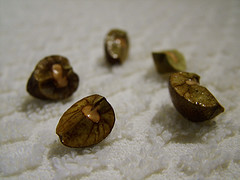
When I was in grammar school, the new school year couldn't begin without at least one classmate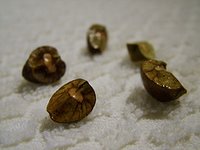 bringing a spastic imitation-coffee bean in a small, clear plastic box because he didn't have seashells or a pair of moccasins to exhibit for show-and-tell. Maybe it's because I'm over 10 (way, way, way, way over 10) that I'm not privvy to the phenomenon of Mexican jumping beans, but then again, I don't recall my niece and nephew ever playing with them. Are they politically incorrect? Bad for the environment? Toxic? I guess the answer is more obvious: They simply are low-tech. You hold one in your palm and it rolls around a couple of times. Big deal. A little brown bean containing a moth larvae jouncing in its final birth throes. Ugh, kinda gross, too. Come to think of it, Mexican jumping beans didn't really hold my attention for more than five, six seconds when I was a kid. Maybe Mexican jumping beans were only a temporary rite of passage even then, a phase that passed faster than jawbreakers and Slinkys. They sure didn't hold a candle to Barbie dolls.
As you have probably deduced, I didn't really have a good blog subject. Then I thought I'd address a vital issue that has been perplexing me as of late: Whatever happened to Mexican jumping beans?
When I was in grammar school, the new school year couldn't begin without at least one classmate
 bringing a spastic imitation-coffee bean in a small, clear plastic box because he didn't have seashells or a pair of moccasins to exhibit for show-and-tell. Maybe it's because I'm over 10 (way, way, way, way over 10) that I'm not privvy to the phenomenon of Mexican jumping beans, but then again, I don't recall my niece and nephew ever playing with them. Are they politically incorrect? Bad for the environment? Toxic? I guess the answer is more obvious: They simply are low-tech. You hold one in your palm and it rolls around a couple of times. Big deal. A little brown bean containing a moth larvae jouncing in its final birth throes. Ugh, kinda gross, too. Come to think of it, Mexican jumping beans didn't really hold my attention for more than five, six seconds when I was a kid. Maybe Mexican jumping beans were only a temporary rite of passage even then, a phase that passed faster than jawbreakers and Slinkys. They sure didn't hold a candle to Barbie dolls.
9.12.2006
RIP Challenge #2 – The Legend of Sleepy Hollow, Washington Irving
 Atmosphere: Hijinks in the air
Chill factor: Sufficiently toe-tingling
What a delightful tale to read. Not spooky (as it seemed when I was a child), but very atmospheric, as this early account of Sleepy Hollow demonstrates:
Not far from this village, perhaps about two miles, there is a little valley, or rather lap of land, among high hills, which is one of the quietest places in the whole world. A small brook glides through it, with just murmur enough to lull one to repose; and the occasional whistle of a quail, or tapping of a woodpecker, is almost the only sound that ever breaks in upon the uniform tranquillity.
That’s a pretty tricky way to lull a reader into a gothic tale. Next, we meet our hapless hero, Ichabod Crane memorably described as:
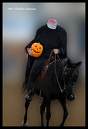
…tall, but exceedingly lank, with narrow shoulders, long arms and legs, hands that dangled a mile out of his sleeves, feet that might have served for shovels…To see him striding along the profile of a hill on a windy day, with his clothes bagging and fluttering about him one might have mistaken him for the genius of famine descending upon the earth, or some scarecrow eloped from a cornfield.
Irving really is a master at description. I especially enjoyed the way he captured the essence of the time and place:
Old farmers, a spare leathern-faced race, in homespun coats and breeches, blue stockings, huge shoes, and magnificent pewter buckles. Their brisk withered little dames, in close crimped caps, long-waisted short-gowns, home-spun petticoats, with scissors and pincushions, and gay calico pockets hanging on the outside.
This story also has to take the prize for Most Memorably Named Characters: Ichabod Crane, Bram Bones, Katrina van Tassel. (Is Shirley Jackson’s Haunting of Hill House echoing Ichabod’s name with Hugh Crain, the owners of Hill House?)
I found it quite interesting how this story – considered one of the earliest examples of literary writing from the new world – deals with fundamental American traits that exist to this day: a can-do belief in the ability to improve one’s status; a naiveté about the larger world, combined with a rapacious sense of individual entitlement; and trust in westward expansion. And maybe Irving is poking a little fun at it, for, woeful as Ichabod is, with his not-very-appealing looks and less-than-appealing career prospects, he positively salivates over the prospect of marrying Katrina:
From the moment Ichabod laid his eyes upon these regions of delight, the peace of his mind was at an end, and his only study was how to gain the affections of the peerless daughter of Van Tassel.
Irving has been criticized by some as having stories with no morals and writing strictly for an audience (the first Dan Brown, perhaps?). But I believe Irving is mocking the superstitions of the townspeople who are “given to marvelous beliefs,” and Ichabod himself, who, though an educated man,
..was, in fact, an odd mixture of small shrewdness and simple credulity. His appetite for the marvellous, and his powers of digesting it, were equally extraordinary; and both had been increased by his residence in this spellbound region. No tale was too gross or monstrous for his capacious swallow.
Couldn’t Ichabod serve as a metaphor of America itself, especially in the immediate post-Revolutionary period (and perhaps even now): Outsized and awkward, starry-eyed while ambitious, impoverished yet abundant, democratic but status-conscious?
At the story’s end, Ichabod pays for his overarching aspirations – and because of his superstitious beliefs. On a ride homeward one lonely autumn night, Ichabod falls prey to the local legend of the Headless Hessian and disappears under mysterious circumstances:
…The schoolmaster now bestowed both whip and heel upon the starveling ribs of old Gunpowder, who dashed forward, snuffling and snorting, but came to a stand just by the bridge, with a suddenness that had nearly sent his rider sprawling over his head. Just at this moment a plashy tramp by the side of the bridge caught the sensitive ear of Ichabod. In the dark shadow of the grove, on the margin of the brook, he beheld something huge, misshapen, black and towering. It stirred not, but seemed gathered up in the gloom, like some gigantic monster ready to spring upon the traveller.
What happened to the hapless Ichabod Crane? We never quite know, though there is much surmising on behalf of the townspeople. A smashed pumpkin near the scene of Ichabod’s disappearance would suggest a prankster in the order of Bram Bones was the true culprit. There is speculation that Ichabod found a new life elsewhere (a reflection of the American belief in the pioneering spirit and westward expansion), but true to their credulity, the townspeople finally are willing to lay blame on the headless horseman. Perhaps the real horror of the story is not that Ichabod Crane could have been carried off by an apparition; rather, it is his lack of bonds to the community and greater world, and the community’s ready dismissal of him (a form of alienation, also a trait peculiar to America):
…when they had diligently considered them all, and compared them with the symptoms of the present case, (the townspeople) shook their heads, and came to the conclusion that Ichabod had been carried off by the galloping Hessian. As he was a bachelor, and in nobody’s debt, nobody troubled his head any more about him.
9.11.2006
9/11 - five years later
At three a.m., the night after the Sept. 11, 2001, attacks, I woke up with a sensation of falling from a great height, suffocated in a cloud of dust. I couldn't sleep. So I took out my pen and notebook. This is what I wrote (unedited):
On Tuesday, Sept. 11, 2001, our landscape changed irrevocably. Not a single shot was fired. No protests were uttered. No cause was identified.
Yet we understand that we are now forced to acknowledge an ideology foreign to us: the power of the unknown.
The lack of overt purpose in the attacks leaves us cold. What is to be gained, we cry. We cannot help it: it is the capitalist in us. Surely, we cannot be appalled at a random act of violence when we live daily with violent crimes that are committed for less reason than pleasure or perversion. We understand and tacitly approve of criminal actions, however despicable and self-serving, if there is gain. Now we are confounded by criminals who, having perpetrated so spectacular a rampage, refuse to claim the spotlight.
What do we do with an unacknowledged enemy that acts on its own terms for no other reason than to satisfy its own set of privately held dogma, whether or not anyone else holds meaning in it? Unlike great revolutionaries of the past— Luther, Lenin, Marx--we are not clear about what action or stance, if any, these terrorists want us to take. Overthrow the government? Protest the war in the Middle East? Eliminate capitalism? Worship Allah? We ourselves are unsure who to hunt; there are no Huns, no Japs, no Blues, Greys, or Reds.
This is a new world order: nomadic ideology, not connected with a state power, a revolution, a civil war. Warriors take their show on the road, like a circus act, playing before a new audience every night. It is battle of happenstance, not fixed, but evolving around a morphing and murky set of conditions. Like foul weather, it appears in various guises, at various times, depending on a fickle mix of elements, such as geography and political climate.
The only sure thing we can hold with certainty after this disaster is terror at the capriciousness of life. On some level, this act of terrorism must force us to acknowledge how out of control modern life is. We feel how fragile our complex infrastructures, how naïve our sophisticated lifestyles, how vulnerable the heart of our civilization is to arrest.
We are living as in a house of cards that can collapse as suddenly and surely as the proud World Trade Center towers.
It is a little like Alice in Wonderland, every time we look to outside forces to blame we end up staring at ourselves in the mirror. If there is any meaning to glean from disaster, it is how we ourselves our complicit in its happening and how we can change ourselves to prevent a recurrence. We cannot control our destinies but we can direct them.
The landscape is scarred; people are dead. These are the tangible indications of change. The soul is shaken; the enemy unseen. These are the elements of a future unforeseen.
Wake up, America. The world is edging in on us, from its many corners.
On Tuesday, Sept. 11, 2001, our landscape changed irrevocably. Not a single shot was fired. No protests were uttered. No cause was identified.
Yet we understand that we are now forced to acknowledge an ideology foreign to us: the power of the unknown.
The lack of overt purpose in the attacks leaves us cold. What is to be gained, we cry. We cannot help it: it is the capitalist in us. Surely, we cannot be appalled at a random act of violence when we live daily with violent crimes that are committed for less reason than pleasure or perversion. We understand and tacitly approve of criminal actions, however despicable and self-serving, if there is gain. Now we are confounded by criminals who, having perpetrated so spectacular a rampage, refuse to claim the spotlight.
What do we do with an unacknowledged enemy that acts on its own terms for no other reason than to satisfy its own set of privately held dogma, whether or not anyone else holds meaning in it? Unlike great revolutionaries of the past— Luther, Lenin, Marx--we are not clear about what action or stance, if any, these terrorists want us to take. Overthrow the government? Protest the war in the Middle East? Eliminate capitalism? Worship Allah? We ourselves are unsure who to hunt; there are no Huns, no Japs, no Blues, Greys, or Reds.
This is a new world order: nomadic ideology, not connected with a state power, a revolution, a civil war. Warriors take their show on the road, like a circus act, playing before a new audience every night. It is battle of happenstance, not fixed, but evolving around a morphing and murky set of conditions. Like foul weather, it appears in various guises, at various times, depending on a fickle mix of elements, such as geography and political climate.
The only sure thing we can hold with certainty after this disaster is terror at the capriciousness of life. On some level, this act of terrorism must force us to acknowledge how out of control modern life is. We feel how fragile our complex infrastructures, how naïve our sophisticated lifestyles, how vulnerable the heart of our civilization is to arrest.
We are living as in a house of cards that can collapse as suddenly and surely as the proud World Trade Center towers.
It is a little like Alice in Wonderland, every time we look to outside forces to blame we end up staring at ourselves in the mirror. If there is any meaning to glean from disaster, it is how we ourselves our complicit in its happening and how we can change ourselves to prevent a recurrence. We cannot control our destinies but we can direct them.
The landscape is scarred; people are dead. These are the tangible indications of change. The soul is shaken; the enemy unseen. These are the elements of a future unforeseen.
Wake up, America. The world is edging in on us, from its many corners.
9.08.2006
Note to self: Be blogworthy
It's Friday, the whole weekend is ahead, and well, I feel compelled to do a blog entry. And avoid a) rewriting a marketing blurb b) revising a short story. Blogs are soooooo satisfactory that way.
Yet, I feel a bit guilty for indulging in this spontaneous, fairly pointless piece when so many fellow bloggers are posting clever, well-crafted, thought-provoking entries. I feel I really must up my blogging game. Starting this weekend, I vow to become blogworthy!
Who cares if I'm a soul-sucked, barren-brained corporate corpse? Other bloggers post novellas with bronchitis, broken arms, new surgery stitches, and five children, two dogs and a hungry spouse waiting in the wings! Buck up, LK! What's a little job burnout?
I shall strive to join the ranks of SuperBloggers, calling on my heroic powers to type faster than a speeding bullet and leap tall thoughts in a single bound! Despite the overwhelming sensation of having cotton-batting perpetually wrapped 'round my brain. Despite the fact that I really love to write off-the-cuff, whereby I can feel smug if the result is felicitous, justified if the work is substandard.
And I vow to improve posts not in the spirit of competition but of comraderie. I want to give to the community the way they give to me! (I am sincere here, in spite of the patented LK flipness.)
And my apologies for not having a really cool blog site. I confess: I am Technically Challenged. In two key ways: First, I am not a programming whiz who lunches on HTML soup, followed by plenty of RSS feed at dinnertime. I am lucky if I can find my computer's ON switch. Someday soon I hope to burnish my blog, clean up the typeface, give the masthead a signature Literate Kitten look and throw in some fancy sidebar tricks for good measure. That is, if I can overcome my second technical challenge: Being hampered by an aging home computer. With my iMac's scant memory fading fast, I work on my blog in dribs and drabs, in between crashes or work breaks, and sometimes flying blind without fully-loaded graphics. Soon, perhaps next week even, a kindly Techno Geek clerk at my local computer store will supply me with the proper vitamins to restore brainpower to my poor, dementiaed iMac.
How I do run on. Happy weekend to all and to all a goodnight.
Yet, I feel a bit guilty for indulging in this spontaneous, fairly pointless piece when so many fellow bloggers are posting clever, well-crafted, thought-provoking entries. I feel I really must up my blogging game. Starting this weekend, I vow to become blogworthy!
Who cares if I'm a soul-sucked, barren-brained corporate corpse? Other bloggers post novellas with bronchitis, broken arms, new surgery stitches, and five children, two dogs and a hungry spouse waiting in the wings! Buck up, LK! What's a little job burnout?
I shall strive to join the ranks of SuperBloggers, calling on my heroic powers to type faster than a speeding bullet and leap tall thoughts in a single bound! Despite the overwhelming sensation of having cotton-batting perpetually wrapped 'round my brain. Despite the fact that I really love to write off-the-cuff, whereby I can feel smug if the result is felicitous, justified if the work is substandard.
And I vow to improve posts not in the spirit of competition but of comraderie. I want to give to the community the way they give to me! (I am sincere here, in spite of the patented LK flipness.)
And my apologies for not having a really cool blog site. I confess: I am Technically Challenged. In two key ways: First, I am not a programming whiz who lunches on HTML soup, followed by plenty of RSS feed at dinnertime. I am lucky if I can find my computer's ON switch. Someday soon I hope to burnish my blog, clean up the typeface, give the masthead a signature Literate Kitten look and throw in some fancy sidebar tricks for good measure. That is, if I can overcome my second technical challenge: Being hampered by an aging home computer. With my iMac's scant memory fading fast, I work on my blog in dribs and drabs, in between crashes or work breaks, and sometimes flying blind without fully-loaded graphics. Soon, perhaps next week even, a kindly Techno Geek clerk at my local computer store will supply me with the proper vitamins to restore brainpower to my poor, dementiaed iMac.
How I do run on. Happy weekend to all and to all a goodnight.
9.07.2006
Thoughts for Thursday - the book score
I love a good book score. That's when you're idly perusing bookstore shelves or rummaging through a free box someone left on the sidewalk and you find...well, a great find. The unexpected. The rarity. The affordable. The title you never dream existed, the book you've sought but never found, the obscure novel by the author whose oueuvre you were certain you'd read in entire. In short, the score.
This week I scored at a local bookstore. I was passing time, waiting for a friend, and I decided to see if this particular bookseller had Volume 2 of Virginia Woolf's Diary. Then I saw it. Wedged in between The Waves and something by Irvine Welsh: The Eye of the Story by Eudora Welty. Two bucks. Yellowed and curled at the edges, with a slice of scotch-tape at the top of the spine. But mine, all mine!
It's one of those books that speak to the other books in your life. In it, for example, there's an essay on Chekhov, whose story Lady with a Dog we just read at A Curious Singularity. And a review of the Western Journals by Washington Irving, whose writings collection, by happenstance, I bought yesterday as part of the RIP reading challenge (Legend of Sleepy Hollow being one of my selections). And an essay on Jane Austen, whose Northanger Abbey is also part of my RIP reading (and which I bought yesterday with the Irving book). Odd, isn't it? I won't even mention the Woolf review included, because it seems any literary essay book worth its salt these days includes something on Woolf.
I've been wanting to respond to a wonderful post by Litlove on the Great American novel and character versus plot, but I've been too swamped. But what of it? My book score conveniently includes an essay on novels! And I quote:
It can be said at once, I should think, that we are all agreed upon the most important point: that morality as shown through human relationships is the whole heart of fiction, and the serious writer has never lived who dealt with anything else.
I'll second that!
This week I scored at a local bookstore. I was passing time, waiting for a friend, and I decided to see if this particular bookseller had Volume 2 of Virginia Woolf's Diary. Then I saw it. Wedged in between The Waves and something by Irvine Welsh: The Eye of the Story by Eudora Welty. Two bucks. Yellowed and curled at the edges, with a slice of scotch-tape at the top of the spine. But mine, all mine!
It's one of those books that speak to the other books in your life. In it, for example, there's an essay on Chekhov, whose story Lady with a Dog we just read at A Curious Singularity. And a review of the Western Journals by Washington Irving, whose writings collection, by happenstance, I bought yesterday as part of the RIP reading challenge (Legend of Sleepy Hollow being one of my selections). And an essay on Jane Austen, whose Northanger Abbey is also part of my RIP reading (and which I bought yesterday with the Irving book). Odd, isn't it? I won't even mention the Woolf review included, because it seems any literary essay book worth its salt these days includes something on Woolf.
I've been wanting to respond to a wonderful post by Litlove on the Great American novel and character versus plot, but I've been too swamped. But what of it? My book score conveniently includes an essay on novels! And I quote:
It can be said at once, I should think, that we are all agreed upon the most important point: that morality as shown through human relationships is the whole heart of fiction, and the serious writer has never lived who dealt with anything else.
I'll second that!
9.05.2006
Virginia's Haunted House
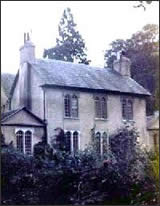
Apparently, Virginia Woolf based her short story A Haunted House on a real house, leased by herself and her husband, called Asham House (pictured here and unfortunately demolished in 1994). Here is what Leonard Woolf had to say about Asham:
Asham was a strange house. The country people on the farm were convinced that it was haunted, that there was treasure buried in the cellar, and no one would spend the night in it. It is true that at night one often heard extraordinary noises both in the cellars and in the attic. It sounded as if two people were walking from room, opening and shutting doors, sighing, whispering…I have never known a house which had such a strong character, personality of its own – romantic, gentle, melancholy, lovely. It was Asham and its ghostly footsteps and whisperings which gave Virginia the idea for A Haunted House and I can immediately see, hear, and smell the house when I read the opening words:
'whatever hour you woke there was a door shutting. From room to room they went, hand in hand, lifting here, opening there, making sure – a ghostly couple.'
RIP Challenge - week 1
Started my reading for the RIP Challenge with Virginia Woolf's A Haunted House. As this was only 3 pages (and my other selections had not yet arrived from Amazon) and a long holiday weekend, I culled my book stacks for other RIP candidates.
Turned out to be a grumpy weekend of reading. I guess I'll have to call myself the Persnickety Kitten this week. Anyway, here goes...
Murders in the Rue Morgue, Edgar Allen Poe. I assumed I've read this at some point, but couldn't recall so I dusted off a copy of Poe's short works and gave it a whirl. What a disappointment. A ridiculous ending, even accounting for the fact that it was the first of the detective genre. I'll be interested in what other readers have to say, see if I can muster some appreciation for it at that point. But for me, Cask of Amontillado is a better story by far.
We Have Always Lived in the Castle, Shirley Jackson. Though Jackson's writing is, as always, fine, I really disliked living with the crazy narrator, plus I figured out whodunit early on. Had to force myself through it. And the ending went way over the top. I revisited The Haunting of Hill House, which is at least spookier (though oddly dated).
That leaves us with: A Haunted House, Virginia Woolf. A mere 3 pages, but the clear winner for weekend number 1. Not sure it really qualifies as a short story (sketch? vignette? pastiche?), but this of all this weekend's RIP readings offered up genuine atmosphere, provocative thoughts and complex texture. The stream of consciousness writing gives an idea of why the living fear ghosts -- They embody our regret for, longing of and reconnection to the past:
Death was the glass; death was between us; coming to the woman first, hundreds of years ago, leaving the house, sealing all the windows; the rooms were darkened. He left it, left her, went North, went East, saw the stars turned in the Southern sky; sought the house, found it dropped beneath the Downs.
Here's hoping that James, Irving or Wharton arrive at my doorstep by Friday!
Turned out to be a grumpy weekend of reading. I guess I'll have to call myself the Persnickety Kitten this week. Anyway, here goes...
Murders in the Rue Morgue, Edgar Allen Poe. I assumed I've read this at some point, but couldn't recall so I dusted off a copy of Poe's short works and gave it a whirl. What a disappointment. A ridiculous ending, even accounting for the fact that it was the first of the detective genre. I'll be interested in what other readers have to say, see if I can muster some appreciation for it at that point. But for me, Cask of Amontillado is a better story by far.
We Have Always Lived in the Castle, Shirley Jackson. Though Jackson's writing is, as always, fine, I really disliked living with the crazy narrator, plus I figured out whodunit early on. Had to force myself through it. And the ending went way over the top. I revisited The Haunting of Hill House, which is at least spookier (though oddly dated).
That leaves us with: A Haunted House, Virginia Woolf. A mere 3 pages, but the clear winner for weekend number 1. Not sure it really qualifies as a short story (sketch? vignette? pastiche?), but this of all this weekend's RIP readings offered up genuine atmosphere, provocative thoughts and complex texture. The stream of consciousness writing gives an idea of why the living fear ghosts -- They embody our regret for, longing of and reconnection to the past:
Death was the glass; death was between us; coming to the woman first, hundreds of years ago, leaving the house, sealing all the windows; the rooms were darkened. He left it, left her, went North, went East, saw the stars turned in the Southern sky; sought the house, found it dropped beneath the Downs.
Here's hoping that James, Irving or Wharton arrive at my doorstep by Friday!
8.31.2006
RIP Challenge - life is now worth living
Remember that semi-awful Elton John song, Someone Saved My Life Tonight? Well, I feel that way about Carl V. over at Stainless Steel Droppings. Just when a stupid-ass work e-mail made me want to drink a bottle of Vitameatvegemin before ramming my head through my computer screen, Carl invented the RIP (Readers Imbibing Peril) challenge. Any daredevil readers willing to take up the gauntlet pick 5 books of chills and thrills to read from this weekend through Halloween. Irresistible!
My one dilemma is that I am committed already to Proust Vol 2 and three Middle East books, plus Henry James, before year's end. Still, I'm with Carl V. -- I never can pass up at least one spinetingler in autumn. I was going to make do with Virginia Woolf's The Haunted House, but this is too tempting. (Sorry, Marcel, I'm a fickle kitten.) So, I negelected my work e-mails temporarily, and drooled over countless titles before arriving at my selections: a little offbeat, very literary, with a smidgeon of humor. A lot like moi.
Now I can take up memos and brochures and PowerPoint slides for the rest of the day.
Thanks, Carl, for giving me something to live for.
LK's RIP Selections
My one dilemma is that I am committed already to Proust Vol 2 and three Middle East books, plus Henry James, before year's end. Still, I'm with Carl V. -- I never can pass up at least one spinetingler in autumn. I was going to make do with Virginia Woolf's The Haunted House, but this is too tempting. (Sorry, Marcel, I'm a fickle kitten.) So, I negelected my work e-mails temporarily, and drooled over countless titles before arriving at my selections: a little offbeat, very literary, with a smidgeon of humor. A lot like moi.
Now I can take up memos and brochures and PowerPoint slides for the rest of the day.
Thanks, Carl, for giving me something to live for.
LK's RIP Selections
- The Turn of the Screw, Henry James (okay, it'll count for my James book at least)
- Legend of Sleepy Hollow, Washington Irving (this is totally revisiting my childhood)
- A Haunted House, Virginia Woolf (is it a horror story? the title counts doesn't it?)
- The Ghost Stories of Edith Wharton (love Edith Wharton, love the fact that she couldn't sleep in a room with a ghost book even in it but managed to churn out some tales of her own)
THIS IS SORT OF LIKE THOSE BONUS TRACKS ON CDs, BUT MAYBE NOT SO MUCH, BUT JUST GO WITH ME--FINAL SELECTION WILL INCLUDE ONE OF THE FOLLOWING, BOTH IF I CAN MANAGE IT OR IF VIRGINIA TURNS OUT TO BE A RED HERRING:
- Northanger Abbey, Jane Austen (a spoof on gothics by Jane Austen? if I can't squeeze it in this year, this is one I will definitely get to at some point)
- Dragonwyck, Anya Seaton (the dark horse, and fairly lengthy given my crunched circumstances, but in the spirit of the event [bad pun intended], I wanted to branch out into new territory)
Thoughts for Thursday - ramblin'
This week I woke up in the middle of the night with a complete blog entry formed in my mind. First thing next morning, I fired up the computer and typed it all in. And then I read it and thought, The only thing to save this from sounding completely moronic would be for CNN's Anderson Cooper to read it live from Bourbon Street. So all I have is this rambling post, powered by the final caffeinated fumes from my brain....So, does anybody really believe GW read The Stranger--at least, the version without pictures? I, for one, don't believe he's ever finished My Pet Goat. He said he was reading about "the battle of New Orleans," which I Googled. Apparently, he's referring to a book by John McPhee, The Control of Nature. Read more here. If you're ever looking for an engrossing book about the Mississippi and how it affected New Orleans and other cities, read John M. Barry's Rising Tide. I learned about Eads and his Bridge (I'm from St. Louis originally, so that was a revelation) and dredging the River and all sorts of terribly interesting, arcane facts about the Old Miss....I am loving In the Eye of the Sun by Ahdad Soueif. The reader in me, who just wants to enjoy the story, is battling the critic in me, which keeps asking WHY I'm enjoying the story. Hell, the reader is winning. Maybe I'll get a post in here replete with in-depth analysis about the book, but right now, I eagerly anticipate my nightly before-bed pages....Okay, back to the grind.
Subscribe to:
Posts (Atom)